We got things started with a community builder…

before moving into our launch.

Here are some of the things folks noticed at our meeting:
- They are copies of each other, but in two different colors.
- Shapes. These frogs have circular toes and I see triangles in how their legs are bent and in the shapes of their bodies.
- A pattern of how they’re facing – symmetry
- On the top two on each side are facing in, underneath two on each side facing out. On top they are encountering each other – on the bottom, they are escaping.
- The pink ones are all going in the same direction (to the right) and the blue ones are all going in the same direction (to the left).
Here are some of the things folks wondered at our meeting:
- They look like they are all the same shape, but is one actually different?
- I am wondering about all the combinations of pink and blue frogs
- Is this a small part of a bigger set? Are there more colors? More frogs? More directions?
- Is this from an animation reel?
- What happens when they encounter each other?
Individual Exploration
I explained that the images had come from a puzzle game. I gave folks about 5ish minutes to play around and explore a bit on their own.
Here’s the link: https://nrich.maths.org/content/00/12/game1/frogs/index.html#/student/2/2

We came back together and I asked everyone: What are you curious about? What questions are coming up for you?
Problem Posing
Here are some of the things folks were curious about:
- I had to make a lot of moves in order to accomplish the swap. It told me I could have done it in fewer moves. How could I have done it in fewer moves?
- How do you maximize it with 2 and 2 or 3 and 3 etc? (“Maximize” meaning finding the most efficient way to do it in the smallest number of moves.) I found a pattern in the minimum number of moves. How does the pattern go backwards? Where are the empty spaces in each step of the sequence? How does the empty spot move?
- I am wondering is there was a formula that could allow you to know the minimal number of moves based on number of frogs?
- It made me think of the slider game with an empty spot. Is there an array version where they can move in more directions?
- It is a leap frog game. I think that the number of pink frogs and number of blue frogs must be the same, 2+2, 4+4, etc to get the pink and blue frog to confront each other face to face. Why do they have to be even numbers (the same of each color)?
I also added a few things I’ve been curious about.
In terms of fewest moves:
- What is the fewest number of moves possible to swap 2 red and 2 blue frogs? 3 red and 3 blue frogs? 4 red and 4 blue frogs?
- Is there a pattern in the fewest number of moves?
- Is there a way to predict the fewest number of moves?
- What is the best strategy for swapping the red frogs and the blue frogs?
Some explorations that involve changing the conditions of the puzzle:
- What happens if you have a different number of frogs on each side?
- What changes if you add more spaces between the lead frogs to start?
Once everyone had a question they were excited to explore, I shared some tools.
Before checking out the tools,
What are you curious to investigate?
Tools
First off, we looked at some of the functionality of the frog puzzle we’d been playing around with.

For folks who wanted to start with some data to look for patterns, I shared a headstart polypad. The polypad has a table listing the fewest moves required to swap 2×2, 3×3, 4×4, 5×5, 6×6, 7x, 8×8, and 9×9. It also had a few models for tracking the movements for 2×2, 3×3, 4×4, and 3×2. For example, here is a model for showing the swap in the fewest number of moves when there are two frogs on each side. Each row is a snapshot of what the arrangement looks like.

I offered a different polypad for folks who wanted to track the trials themselves, using the same visual system that wasn’t already filled in.

Ramon also shared this paper and pencil system for tracking the moves (and the “empties”).

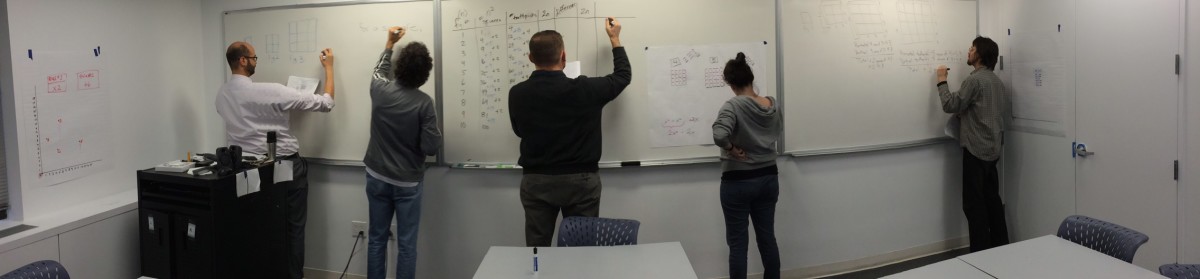
Then we broke into groups based on what we each wanted to investigate and worked for about 45 minutes.
Group Share
LINDA and MAYA
Linda and Maya focused on finding the fewest moves required for swapping two pink frogs with two blue frogs. One breakthrough moment they described was not alternating back and forth between pink and blue. The realized that in order to not get “blocked in” and have to waste a move sliding a frog backward, they sometimes needed to move two pink or two blue frogs in a row. After persevering and trying different strategies, they were able to swap the frogs in eight moves: Pink, Blue, Blue, Pink, Pink, Blue, Blue, Pink. They started working on the puzzle with three frogs on each side and got it down to 17 moves, which is close to the fewest moves (15).
AMY and PARKER
Amy and Parker were looking at how the numbers of moves grew with increasing numbers of frogs and thinking about functions and operations that might grow in similar ways. Their investigations led them to explore proportional growth, inverse growth, quadratic growth.
They set variables to look at the total number of frogs (R+B), the total number of spaces (R+B+1 or S), the total moves (M), and the difference between the number of frogs on each side. The generated some data using those variables for 2R and 2B, 3R and 2B, 3R and 3B, 4R and 4B, and 4R and 1B. They used their data in a series of operations to try to match the growth in their data.
They used the number of moves as a target. They tried using relationships between the variables as a multiplier to match the number of moves.
They explored questions about what happens when there are different numbers of frogs on either side. That got them curious about the difference, or absolute value, between the number of frogs. They noticed that the larger the absolute value of the difference between the number of frogs, the fewer the number of moves required to swap them. The more symmetrical the board, in terms of the number of frogs on each side, the more traffic which requires more moves (jumps) to resolve.
They tried dividing by the absolute value of the difference between the numbers of frogs plus one (so as not to divide by zero) because they were thinking that if that number was bigger, the number of moves would be smaller.

SOLANGE
Solange shared part of her approach, which moved from representational to abstract. Look her work. What do you notice? What do you wonder?

Solange was looking at how many moves it takes to swap the frogs. She was also looking for patterns in how the swaps happen. She noticed a symmetry in each sequence.
1, 1, 1 for 1 frog on each side. 1 2 2 1 for 2 frogs on each side. 1 2 2 3 2 2 1 for three frogs.
- She saw that the blocks grow until they match the number of frogs on each side.
For 3 frogs, the blocks grow 1, 2, 3.
For 4 frogs, she saw 1, 2, 3, 4.
For 5 frogs, she saw 1, 2, 3, 4, 5.
- Then we see the highest number repeat.
- And then the numbers come back down again.
For 4 frogs it goes 1 2 3 4, then 4, then 4 3 2 1 for four frogs
For five frogs, the pattern goes 1 2 3 4 5, then 5, then 5 4 3 2 1 .
She mapped out the rhythm of each turn and noticed a few things.
Solange recognized the triangular numbers (which are produced by adding consecutive whole numbers): 1, 3, 6, 10, 15, 21… (1, 1 + 2 = 3, 1 + 2 + 3 = 6, 1 + 2 + 3 + 4 = 10)
Since the numbers go up and then back down she multiplied the triangular numbers by 2. 1×2, 3×2, 6×2, 10×2, 15×2, etc.
Next she came up with an equation to describe the fewest number of moves to swap the frogs.
- The pattern is triangular numbers, a repeat of the highest number, and a repeat of the triangular numbers. You can look at it as the number of frogs in the center, with two “wings” of triangular numbers on either side.
- The triangular numbers can be represented as n(n+1)/2.
- So we can see the fewest number of moves as:

Which she simplified to n2 + 2n
Solange verified her findings using a data table. She calculated the “rate of change” between the total moves (3, 8, 15, 24, 35). By writing the differences (5, 7, 9, 11), we can see the gap was growing by 2 every single time. When the second differences are the same, the relationship is quadratic.
MARK
Mark came up with three different equations for figuring out the fewest number of moves required to swap any number of frogs.
He used a similar data table to look for patterns.

From past CAMI meetings, he knew that if the second difference is 2, that the equation would have an n2 in it.
So he added a column where he squared all the inputs (the number of frogs on each side). Then he made a column for the differences between the 2nd and 3rd columns. Then he noticed that the differences were always twice the number of frogs on either side.

His first rule for predicting the fewest moves required to swap the frogs was:
n2 + 2n
He was curious to see what happened if there was a different number of frogs on either side. Say 3 pink frogs and 2 blue frogs. His question was, how do you square and double numbers that are not the same? So he tried multiplying the number of frogs on either side. Then, instead of thinking of 2n as double the number of frogs on each side, he realized he could also think of that number as the total number of frogs. So he tried the equation (n x m) + (n + m), which also works. For example: the fewest number of moves you need to swap 3 red frogs and 2 blue frogs is (6) + (5) = 11.
Mark came up with a third equation looking back at his initial data table.

In stead of looking at how the outputs were changing (looking “down”), he looked “across,” from the inputs to the outputs. He saw that the fewest number of moves is the number of frogs on one side multiplied by 2 more than that number, or n(n+2)
- 2(4) = 8
- 3(5) = 15
- 4(6) = 24
- 5(7) = 35
- 6(8) = 42
- 7(9) = 63
- 8(10) = 80
- 9(11) = 99
Mark also got curious about patterns in how the swaps happen. He used the polypad to track whether a move was a SLIDE (S) or a HOP (H). He discovered other symmetrical patterns.


AREN
After a lot of other explorations and had already arrived at the formula by other means, Aren wanted to figure out the formula by telling a story, where the story was a way of making sense of where the parts of the formula came from.
They shared their main polypad will all their other frog explorations.
The first story was about 3 red frogs and 3 blue frogs. To get to the final position, each frog has to travel a total of 4 spaces. Since there are 6 frogs, the total distance to be traveled is 24 spaces. Also, each frog had to get past 3 frogs of the other color. To get past a frog of the other color, a frog has to hop over or be hopped over by another frog, so each frog has to participate in 3 hops (either as the hopper or the hoppee). 6 frogs participating in 3 hops each makes 18 hops, but each hop switches 2 frogs, so only half as many or 9 hops are needed. Each hop covers a distance of 2, so 9 hops cover a distance of 18. Since the total distance traveled has to be 24, there are 6 more slide (non-hop) moves to make. 9 hops and 6 slides makes a total of 15 moves.
Here’s similar reasoning applied to 3 red frogs and 2 blue frogs:
The field is 6 spaces (3 red + 2 blue + 1 empty)
The three red frogs each have to move 3 spaces. (6 total – 3 red)
The two blue frogs each have to move 4 spaces. (6 total – 2 blue)
The total travel distance is 3×3 + 2×4=17
Each red frog has to pass each blue frog (3 frogs x 2 hops)
Each blue frog has to pass each red frog (2 frogs x 3 hops)
So, 12 hops, but divide by 2 to get 6 hops.
6 hops covers 12 spaces
So 5 spaces need to be covered by slides.
6 + 5 = 11
In general:
For R red frogs and B blue frogs
Each red frog has to travel a distance of one more than the number of blue frogs or B + 1, so the total distance traveled by red frogs is R(B+1).
Similarly, the total distance traveled by blue frogs is B(R+1).
The total distance is the sum of those two expressions:
R(B+1)+B(R+1) = RB + R + BR + B = 2RB +R + B.
Each red frog needs to participate in B hops (RB hops), and each blue frog needs to participate in R hops (BR hops), but that counts every hop twice, so the total number of hops is just RB.
Each hop covers two spaces, so we can find the number of slides by subtracting twice the number of hops from the total distance:
2RB + R + B – 2RB = R + B.
So… the total number of hops is RB and the total number of slides is R + B which means the total moves is RB + R + B.
They also did a little exploration of frogs in 2 dimensions (kind of like Amy’s question/thought about the sliding tiles game):

Once again, a simple set-up yielded many questions and ribbit holes… ahem, rabbit holes, to explore.
