We started this meeting with a collection of four images and asking what is the same and what is different:

Here are some things we noticed:
- All the images have 10 squares with a star in one of them.
- They are different colors and are arranged differently.
- All of them except the red one look like they have two squares missing from them.
- The red one does not look like a shape.
- Three of them have stars at the bottom and one has a star at the top.
We then revealed that these are all examples of a puzzle where the object is to draw a single continuous path that starts at the star and passes through each square exactly once. The path can’t go diagonally and can’t pass through any non-colored areas. Here’s an example of a puzzle and a solution.

Once we understood the rules of the puzzle, we spent some individual time playing with puzzles and thinking about what we’d like to explore. You can play with them too at this Polypad.
Here are some general ideas and questions that emerged from our exploration:
- Sometimes you realize before you finish a path that it’s not going to work. How do we know a path is not going to be a solution without finishing it?
- Is symmetry part of how this works?
- Some of the puzzles seem more “connected” because they don’t have gaps in them. Does this affect whether a puzzle is solvable or how hard it is?
The idea of connectivity was very interesting because it was language that we developed together to help us talk about the puzzles. We eventually decided that we could talk about how connected a puzzle was (like did it have a lot of gaps or not?), but we could also talk about how connected an individual square was (was it surrounded by other squares or sticking out on its own?).
As a group, we were most interested in trying to solve some of the more challenging puzzles. We decided to all work on the same one. (Here’s a Polypad where you can try this puzzle.)

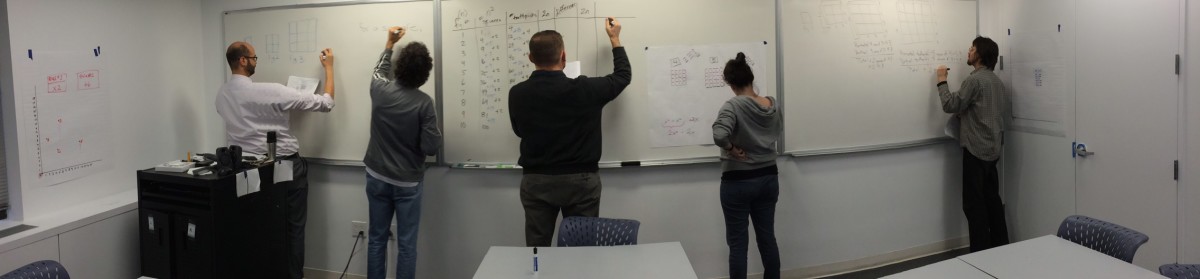
We used multiple copies of the puzzle so we could have a record of our thinking and build on strategies that were unsuccessful. Here is a record of our work (plus a couple other directions folks explored):

Some notes from our play time:
- We noticed that when our path seemed to leave some squares unconnected, we knew it wasn’t going to work.
- Maya experimented with filling in the gaps in the puzzle to see if that made it easier to solve.
- We weren’t sure it was solvable, but when Aren said that a computer had said there was a solution, it helped us be more persistent in looking for it.
- Amy explored the idea of regions of a puzzle that you have to be able to go into and get out of.
- Linda tried a systematic approach of trying each possible direction from the starting square. It quickly got overwhelming because there were more choices at every step!
- Maya said she thought that the square in the lower left had to be the ending square because it only was connected on one side.
- Aren suggested that if we knew the ending square, we could also use it as a starting square for a different perspective.
- Linda said that Maya’s idea about the ending square helped her think outside of the box and not give up.
Our biggest takeaway – Thinking outside the box and being inspired by others’ work help us be persistent.
