
Cindy started the meeting by asking participants to draw rectangles in Jamboard using the graph paper background.
Tip: To make a straight line in Jamboard, hold down the shift key!

Community of Adult Math Instructors (CAMI)
teachers learning math together
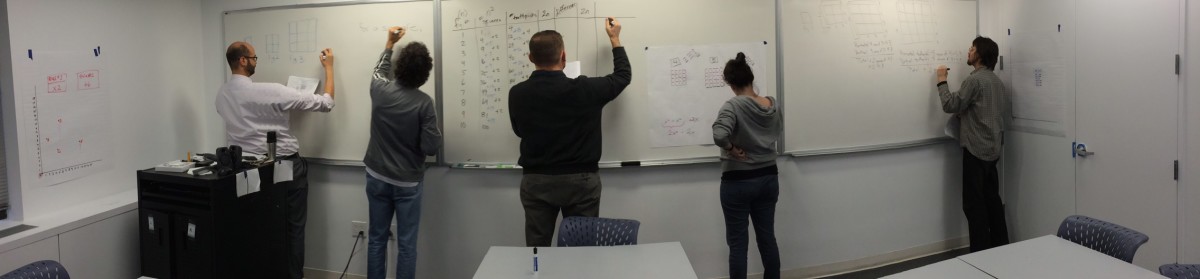
Cindy started the meeting by asking participants to draw rectangles in Jamboard using the graph paper background.
Tip: To make a straight line in Jamboard, hold down the shift key!
Sarah and I have been meeting once a week to teach ourselves some basic coding. Our first project was a function game. We are currently working on another game involving sequences, which got us thinking about the sequences in this meeting.
Sarah started this meeting by asking the group to consider the following prompt.

Sophie led us through the following problem from the Museum of Math’s weekly puzzle during COVID. Sign up for emails from MoMath.
PUZZLE: Coconut Classic
Five men and a monkey, marooned on an island, collect a pile of coconuts to be divided equally the next morning. During the night, however, one of the men decides he’d rather take his share now. He tosses one coconut to the monkey and removes exactly 1/5 of the remaining coconuts for himself. A second man does the same thing, then the third, fourth, and fifth. The following morning the men wake up together, toss one more coconut to the monkey, and divide the rest equally.What’s the least original number of coconuts needed to make this whole scenario possible?
Mind-Benders for the Quarantined! (Museum of Math, NYC)
We had a lot of interesting ideas and shared a few strategies, but we didn’t get to a solution.
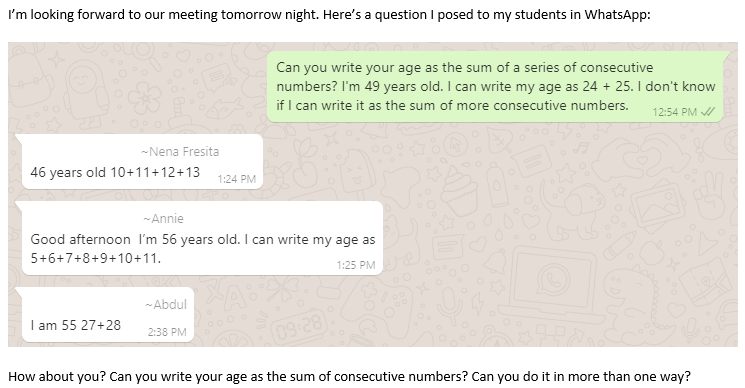
Continue reading “A pile of coconuts”In this meeting, we explored the sums of consecutive numbers (inspired by a CAMI meeting led by Usha Kotelawala in June 2017). The meeting is also based on a two-day lesson I led with the support of other teachers during summer 2020 problem-solving meetings with CUNY adult education students.
Before the meeting, I shared this post on the CAMI email list:
In this meeting, we explored Henri Piccioto’s number pyramid puzzles through notice/wonder, generating questions for problem-solving and additional puzzles for students.
At the beginning of the meeting, we shared some favorite sources of puzzles we like to use with students, include Which One Doesn’t Belong, Sometimes, Always, Never, and Open Middle.
Then I introduced Number Pyramids. Thank you to Henri Piccioto and his amazing web site of math resources. Here is the sequence we used:

A simple situation with a mother and daughter’s ages leads to many questions and interesting observations.
In August, at a summer board meeting of the Adult Numeracy Network, the fabulous Sarah Lonberg-Lew (@MathSarahLL) shared a problem. Well, it wasn’t really a problem, more like something she noticed. In the meeting, she asked what we noticed and what questions we might ask.

Solange led us in a meeting about teaching mathematics with a focus on discovery, investigation, and student thinking.
In this meeting, Solange presented us with the following problem:
Consider a collection of pennies with the following constraints:
When the pennies are put in groups of 2 there is one penny left over. When they are put in groups of three, five and six there is also one penny left over. But when they are put in groups of seven there are no pennies left over. How many pennies could there be?
Thank you to YouCubed.org for the problem.
Can you help us out? Can you find a solution? Can you find more than one? What strategies are you using?
Continue reading “Penny Collection”We moved shapes around a 100-grid to find patterns that lead to algebraic generalizations.
Today’s problem was from this year’s annual meeting of the Adult Numeracy Network (ANN) at the COABE conference in New Orleans. Christin Smith, Patricia Helmuth, and Heidi Schuler-Jones led the group through a series of activities over the course of the day. The theme of the ANN annual meeting was the idea of revealing algebra in basic mathematics. In our CAMI meeting, we explored an activity that starts with adding on a 100-grid and finding patterns and then moves towards generalization.
Continue reading “Pentominoes!”Usha and Sophie led a frenzy of folding, observing, counting, and predicting at Fashion Industries High School.
Update: Check out these related videos —> Numberphile | Doodling in Math Class | Wrong Turn on the Dragon
It was a beautiful spring day when Usha and Sophie represented CAMI at the 40th anniversary of the New York City Adult Basic Education Conference. Sophie gave a little history of CAMI…
Starting with a colorful visual representation of numbers, we looked at a series of problems based on prime factors.
For the last few months, I’ve been working on study materials on exponents and roots. While doing research for the packet, I started to get interested in factors and especially prime factors. It turns out that they are really useful for thinking about lots of different kinds of math that we have been looking recently. For example, the mathematics of bicycle gears or Spirograph both have to do with factors, as do fractions, place value, exponents and other math that is relevant to math teaching in adult literacy.
Continue reading “Playing with Prime Factors”


