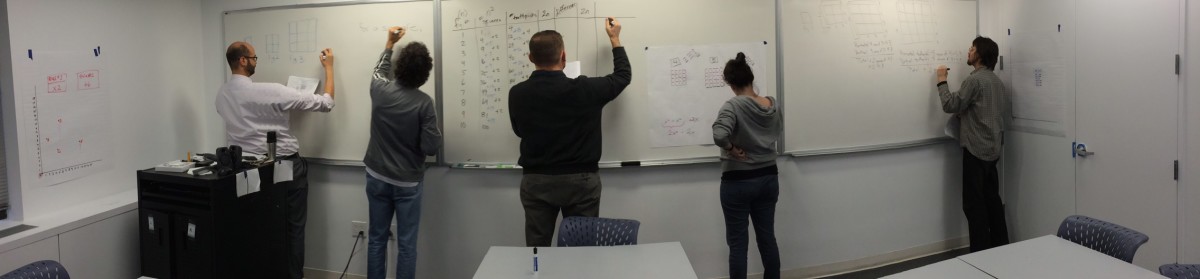
At this meeting, looking for something new in the familiar, we explored subtraction.
We challenged ourselves to find methods to subtract, beyond the standard algorithm of “borrowing” (which is not really “borrowing” at all!). Then we used those methods as leaping off points to ask questions to push our understanding about how subtraction works.
Number of the Day
We started with a number of the day to stretch and warm-up.


- [6 x -10] + 107 – Maya
- 500-400-50-3 – Kim
- 5^2 + 5^2 -3 – Nathan
- 23 + 24 – Mark
- 11 + 11 + 12 + 13 – Mark
- Dots (1+2+3+4+5+6+7+8+11) – Aren

Next, we moved into a three-digit subtraction problem, with the task to solve it in as many ways as we can.
Subtraction

After we came up with different strategies on our own, we got into pairs and shared our approaches. We took some time examining our partner’s strategies. Then we took turns sharing our interpretation of our partner’s strategy.
Below are the strategies we came up with. Take a look at the different strategies and choose a few to investigate. What did the person do? How does the strategy work? What do you appreciate about the strategy?


After we shared some our the strategies from our partner work, we did some problem-posing together, brainstorming questions we were curious to investigate.
What Questions Do We Have?
- Absolute Value
- How can we better understand absolute value? (Absolute value)
- Is there some way that subtraction actually follows the commutative property making it ok to move the numbers?
- 5-3 = |3-5|. Is |187-234| equal to 234-187? Is that always true? Why?
- Negative Numbers
- How can we use negative numbers instead of borrowing in subtraction?
- Subtraction Strategies
- How can we use rounding to help us subtract? To make it easier to subtract?
- Does viewing the subtraction problem from bottom to top, does that help us better understand the problem?
- Are visual representations better for adults and kids?
We organized our group time into (1) exploring different subtraction strategies, (2) thinking about absolute value and subtraction, (3) using negative numbers instead of borrowing.


In addition to the math questions we posed in the heart of the meeting, we ended with some teaching questions to explore.
Teaching Questions
In the spirit of CAMI meetings, ending with questions to take with us, a few folks shared a few teaching questions raised through the meetings activity:
- What is the value of regrouping thinking?
- How can we organize our algorithms into the best skills that matter?
- What do we gain or lose with different strategies?
- Could introducing negative numbers at this point in students’ math journey be helpful (rather than waiting until we get to algebra)?
