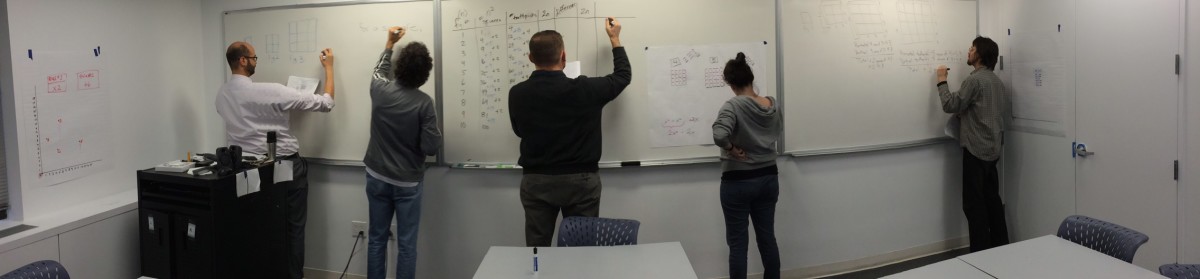
At the heart of this meeting was the following table, shared by math educator Howie Hua:
What do you notice? What patterns do you observe?

Here are some of the things we noticed:

Next, we did some individual exploration, using the patterns to investigate whether 1000 will appear in the table.
What do you think?

Before anyone had an answer as to whether 1000 appears in the table, we came back together to share questions that were coming up for us and things we were curious about. Those questions can be divided up into 2 categories.
Questions about relationships in the table and how the table looks
- Are there diagonal patterns? Like from 10 to 28 to 72. Or 40 to 28 to 18.
- How can we fill in the table without using the top row and first column?
- If we express the numbers as products of factors, what might become visible? What could finding the factors show us with the numbers not in the top row (odd numbers) or first column (powers of 2)?
Questions about what numbers show up in the table (and what numbers don’t)
- Will 1000 show up?
- What numbers will show up and what numbers will not?
- If 1000 doesn’t appear in this table, how could I change the top row or first column to produce a 1000?
- If 1000 is not in the table, are there other numbers not in the table?
GROUP 1 – Maya, Ruben, & Aren
Group 1 focused on whether or not 1000 appears in the table. They kept making and testing conjectures, exploring different ways to explore the question. One approach was thinking about the columns. Maya noticed that the 5 column was the only one with numbers ending in zero – could 1000 appear in that column? Are there other odd numbers that would create numbers ending in zero if we doubled them? Ruben was thinking along similar lines – what numbers could we double to get to 1000? – wondering how to place 500. Then their approaches shifted to thinking about how to get numbers that are close to 1000. For example, Maya asked how close we could get to 1000 in the first column – the answer being 1024. 15 x 64 is 960 and 17 x 64 is 1088, other close answers. Ruben also wondered about factors, recognizing that 100 is a factor of 1000, but what two numbers on the table could produce 100? Group 1 displayed a lot of perseverance and productive struggle, making observations and trying to use relationships to focus in on 1000.


GROUP 2 – Amy, Jeniah, & Mark
Group 2 started with the question of whether 1000 appears on the table.

Next group 2 was curious to see if there was some generalization they could come up with.

- Starting with the idea that the products on the table are created by multiplying a power of 2 (R) by an odd number (C).
- Powers of 2 can be generalized as 2^r.
- Odd numbers can be generalized as 2c+1 or 2c-1: because any even number can be expressed as 2x. You can imagine it as an array of rectangles. Every even number can be represented by a rectangle that is 2 by anything. For example, we can make 12 with an array that is 2 by 6. We can make any odd number then, by adding or subtracting one.

- Because Row 1 is actually 2^0, we had to figure out a way to start with 2^0. So 2^r became 2^(r-1). In other words, Row 1 starts with 2^0, Row 2 starts with 2^1, Row 3 starts with 2^2, etc.
The group wanted to change up their perspective and decided to look at the bigger picture. Amy decided that if given any number, she could figure out whether it would appear in the table.
Amy’s steps for figuring out if a number is on the table:
- Express the number in its prime factorization
- Separate out the powers of 2
- Multiply the other prime factors together.
- If the number can be expressed as the product of an even number and a power of 2, then it will appear in the table.
So, what numbers are on the table? What can we say about the numbers on the table?
- They are all the products of an odd number and a power of 2
- They are all even
AMY’S CONJECTURE: Pretty much anything with a factor of 2 is on the table. Which is every even number. All even numbers will appear in the table. And since the top row is made up of every odd number, then every whole number will appear in the table.
The realization that every whole number appears in the table raised the question, what patterns would emerge if we connected the numbers in sequence. We set some conditions for ourselves – (1) we would try to connect the numbers consecutively without crossing the lines and (2) we would go above every number (to keep things consistent). There was not much time in the meeting, but this was the beginning of our investigation (counting from 1 to 20):

New Questions:
- We ran out of space because of how close the numbers are. Can we make the cells larger? How large would they have to be?
- What other aesthetic choices can we make to go through the table and connect the numbers consecutively?
- What would it look like if we express the products as coordinate points using the odd #s and powers of 2 as the x and y?
- Can we make this with string?
