
Introduction
Do you play cards? What kinds of cards do you play? What do cards have to do with probability?
Community of Adult Math Instructors (CAMI)
teachers learning math together
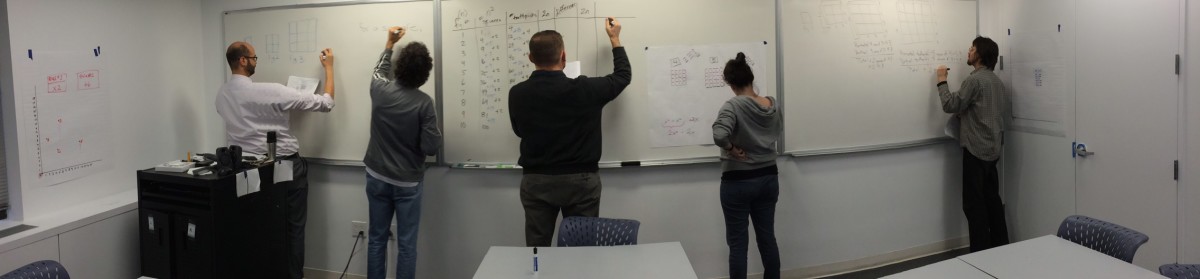
This was the third time CAMI tried out using a 3-Act math task. This one is called Royal Flush and is organized around the probability of a poker hand in Texas Hold’em.
Do you play cards? What kinds of cards do you play? What do cards have to do with probability?
The CAMI Roadshow worked with teachers at the 2015 NYC ABE Conference
We talked about problem-posing and inspiring student curiosity in math as we tried out a three-act math task created by Dan Meyer
To start off the meeting, in pairs we discussed – “Real life math”: What does it mean to you? In your classrooms?
At this CAMI meeting we looked at 3 different problems:
We can get conditioned to approach visual patterns in a particular way and jump immediately to the problem of looking for the nth figure (# of squares, for example). Beginning with an open, problem-posing approach can help break us out of that habit and really open up the mathematics.
Usha led us through an exploration of a visual pattern, building off of the work we’ve done at the last two meetings. She used problem posing to enable us to have greater ownership on the problem and to widen options to explore.
We wanted to build off the problem from last meeting, exploring visual patterns, with a focus on different ways of approaching these problems and how can we bring them into the classroom.
Still looking for a name for our group, we went around introducing ourselves and each offered one word for our group vision:
Fun, Math, Community, Community, Building, Sharing, Other People’s Thoughts, Resources, Escape, Learning, Ideas, Adult/Young Adult, Inspiration
“No matter how kindly, clearly, patiently, or slowly teachers explain, they cannot make students understand. Understanding takes place in the students’ minds as they connect new information with previously developed ideas, and teaching through problem solving is a powerful way to promote this kind of thinking. Teachers can help and guide their students, but understanding occurs as a by-product of solving problems and reflecting on the thinking that went into those problem solutions”
(Lambdin, 2003)


